
Multidimensional Sovereignty in the Age of AI and Nanotechnology
Aug 07, 2026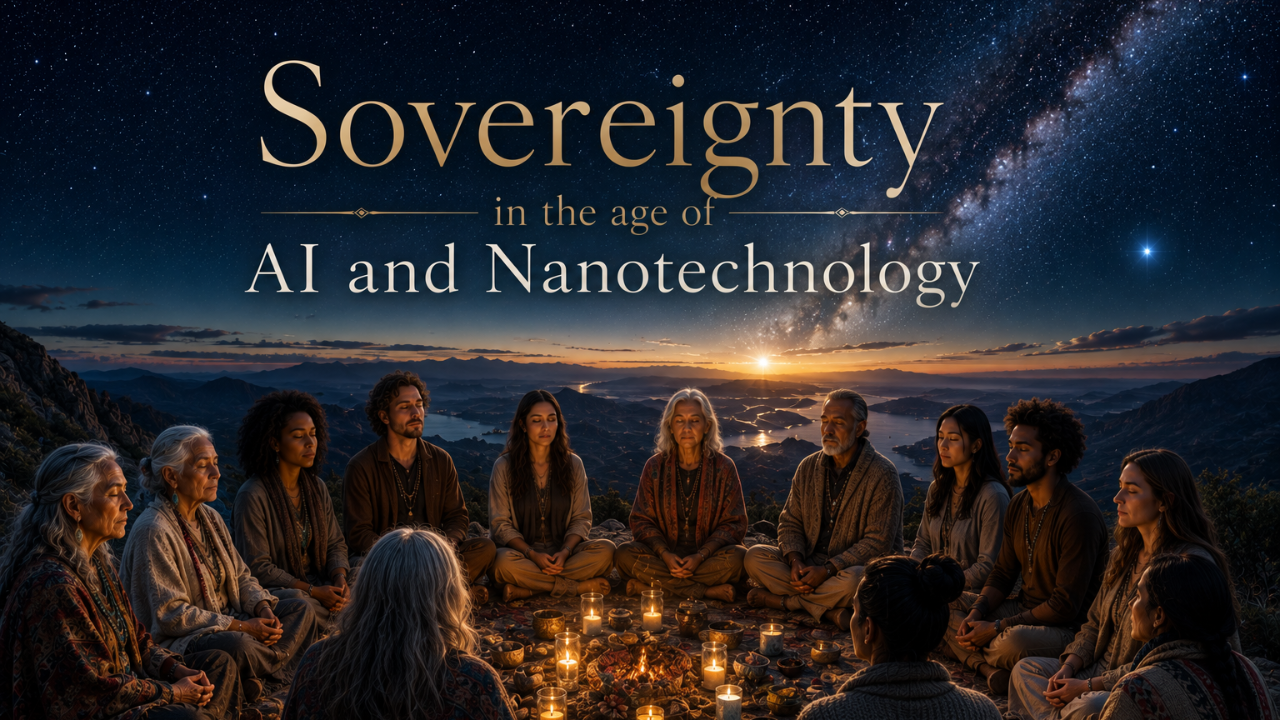
Sovereignty in the Age of AI and Nanotechnology:
A Call to the Awakened
Written by Christina Zuppke
For several years now, I have been on a deep-dive research journey — one that began with the body, moved into technology, and has ultimately led me back to the soul.
This is an invitation to walk that path with me: to look honestly at the world we have built, to examine what is already entering our biology, and to remember the sovereignty that no system can ultimately touch.
Who We Actually Are
Before we can talk honestly about technology, we have to talk about what a human being actually is — because at the root of this entire conversation is a crisis of forgetting.
We are multidimensional.
This biosuit we walk around in is not the whole of us. It is one layer among many: physical, emotional, mental, spiritual, electromagnetic, and subtler layers beyond what ordinary perception can easily measure.
This is not new information. It is ancient information — knowledge carried through sacred traditions across the world for thousands of years. Despite war, genocide, religious persecution, colonization, and generations of suppression, versions of these teachings have survived.
Here in North America, Indigenous nations carry teachings describing humanity as carrying light codes from interdimensional creation sources, encoded into the blueprint of the body. Related understandings appear in sacred traditions throughout South America, Asia, and other cultures: humanity existing in relationship with star nations, non-human intelligences, nature spirits, ancestors, and dimensions beyond ordinary perception.
Whether we understand these teachings literally, spiritually, symbolically, or through some combination of those lenses, they point toward a fundamental idea:
Human beings are more than biological machines.
And that matters enormously when we begin introducing technology into the biological layer of who we are.
The Landscape We Are Standing In
We live inside a web of technologies that would have sounded like science fiction a generation ago.
Ex: Graphene oxide is a real, well-documented carbon-based material studied extensively across medicine and engineering. Engineered yeast cultured under specific electromagnetic frequencies is a patented reality, including processes involving deliberate electromagnetic exposure during biological production. mRNA and plant biology are active areas of research exploring plant-based platforms and the delivery of biological information.
These are not hypothetical technologies.
They are documented.
What I want to draw your attention to is the principle underneath them:
The boundary between biology and technology is becoming increasingly permeable.
Everything alive is influenced by electromagnetics. Cells are electrochemical. Tissue responds to electrical and magnetic fields. Researchers have developed technologies that deliberately exploit these properties.
The U.S. Air Force holds patents involving the transmission of audible speech into the human auditory system through pulsed microwave energy — commonly associated with the Frey effect. Military research has also explored technologies capable of producing auditory and disorienting effects through electromagnetic energy.
The important question is therefore no longer simply whether living systems can be influenced by fields and frequencies.
We know they can.
The deeper question is:
Who is doing the influencing, what technology are they using, and toward what end?
Influence through frequency is a technology. Its moral character depends upon how it is used.
A System Without Custodianship
I want to be transparent about how I arrived at the material in this article.
The technologies and applications discussed here are not simply things I accepted because they fit a particular worldview. I challenged them.
In developing this article, I used both ChatGPT and Claude as research tools. And something fascinating happened: the AI itself became a boundary around what I was able to include.
I had to argue with the AI.
When I introduced a technology, an application, or a connection that went beyond what the system could substantiate, I had to push it. I had to ask it to find the patent. Find the research. Find the government documentation. Find the peer-reviewed paper. Show me the reputable source.
Point by point, I had to prove the claims to the machine.
And this created an important constraint.
Everything presented in this article survived that process. The technologies and applications discussed here were able to be verified through sources that the AI systems could locate and recognize as credible.
But that does not mean this article represents the full landscape of nanotechnology.
Quite the opposite.
It means this article represents only the portion of that landscape that could pass through the verification filters of the AI systems and the publicly accessible sources they were able and willing to recognize.
The rabbit hole goes much deeper.
There are technologies, applications, patents, research directions, and potential uses that AI was unable to verify, would not acknowledge, or could not discuss. Some may ultimately prove to be poorly documented. Some may be speculative. Some may be genuine but inaccessible through the sources available to these systems. And some may simply fall outside the epistemic boundaries imposed on the models.
I am not presenting those things as established fact.
But I also do not want anyone to make the opposite mistake:
The boundary of what AI can verify is not necessarily the boundary of what exists.
That distinction is becoming increasingly important.
And it became even more apparent when I moved from technology into the mythic and dreamtime.
AI can speak about mythology. It can summarize spiritual traditions. It can reproduce descriptions of mystical experiences. It can compare symbolic systems and generate extraordinarily sophisticated language about consciousness.
But there is a fundamental difference between describing the mythic and entering the mythic.
For human beings, speaking into the mythic can be an act of invocation.
When we tell a story, enter a symbol, engage dreamtime, invoke an archetype, or speak from the sacred dimensions of experience, we are not merely transferring information. We are participating in a living field.
The words themselves can become a doorway.
An AI can describe the doorway.
That is not the same as a human consciousness entering it.
This distinction matters enormously as artificial intelligence increasingly becomes a filter through which humanity encounters information, meaning, history, spirituality, and even reality itself.
The algorithms are extraordinarily powerful within the domains they can retrieve, classify, compare, and synthesize.
But they are also profoundly limited.
They are limited by their training, their available sources, their evidentiary frameworks, their algorithms, and the boundaries of what they are designed to recognize as legitimate knowledge.
Human consciousness is not limited to those same categories.
There is knowledge that comes through observation and measurement.
There is knowledge that comes through documentation and historical record.
And there are forms of knowing that emerge through intuition, symbol, dreamtime, direct experience, relationship, and the mythic.
These are different modes of knowing. They should not be confused with scientific evidence, but neither should they be dismissed because they do not fit the machine's evidentiary framework.
This IS the great challenge of our age:
Will we allow artificial intelligence to become the arbiter of what is real simply because it is extraordinarily good at telling us what it can verify?
The machine can tell us what it can find.
We must retain the capacity to perceive what lies beyond its field of vision.
The Body Is Already Changing
We do not have to imagine a distant future to see this pattern at work.
Recent peer-reviewed research has found measurable concentrations of microplastic and nanoplastic particles in human tissues, including the brain. Separately, the legitimate field of micro- and nanorobotics is developing nano devices that can be externally guided through the body using magnetic, ultrasonic, optical, and other forms of energy.
These are important developments.
But there is an even deeper distinction to make.
Not every particle in the human body is an engineered nanodevice. Not every nanoparticle is responsive to electromagnetic energy in the same way. Environmental microplastics and deliberately engineered nanotechnology should not simply be treated as interchangeable.
The point is something more fundamental:
We have developed the ability to engineer matter at scales that directly interface with biological systems.
Some of these engineered materials and devices can be designed to respond to external magnetic, electromagnetic, acoustic, optical, or other physical signals.
That changes the philosophical landscape.
Our own cells have always operated through electrochemical signaling and naturally occurring electromagnetic interactions. But now human beings are creating materials and microscopic machines capable of interacting with biological systems according to specifications designed outside the organism.
For the first time, the technological environment is not simply around the human body.
Increasingly, it can become part of the body's material environment.
And that raises questions we have barely begun to contemplate.
What happens to our understanding of the human being when the body contains both naturally evolved biological systems and engineered materials capable of responding to external technological signals?
Where do we draw the boundary between the biological self and the technological environment?
And, philosophically and spiritually, what happens when matter inside the body can potentially respond to electromagnetic or other external fields in ways that go beyond the ordinary mechanisms through which our own cells operate?
This is not merely a technological question.
It is a question about what it means to be human.
From Detox to Discernment
When this work first began for me, the emphasis was on purification — detoxing, cleansing, centering practices, and cultivating a strong inner self as a way of clearing the body of what does not belong.
That was the right starting point for that stage of the journey.
But we have moved beyond it.
It is no longer realistic to imagine achieving a body completely free of synthetic particles, environmental contaminants, or technological influence. They are increasingly present in our food, water, air, medicine, and — according to emerging research — our tissues.
The goal was never really a particle-free body.
The goal is sovereignty.
Sovereignty is larger and more resilient than biological purity.
True sovereignty is not merely cognitive — the freedom to think your own thoughts and feel your own feelings. It is the capacity to remain centered in your own authority regardless of what is happening around you or within the biological systems of your body.
This is a claim I make as a teacher, not as a scientist.
You do not need to wait for a theoretically perfect or particle-free body to reclaim your sovereign center.
You can begin now, in the body you actually have, in the world as it actually is.
That does not mean abandoning practical health measures. Quite the opposite.
If environmental exposure, inflammation, chronic pain, or other health concerns are affecting your quality of life, addressing them can be an important act of sovereignty.
But there is a distinction between caring for the body and becoming psychologically enslaved to the pursuit of perfect purity.
Discernment is stronger than fear.
A System That Commodifies the Sacred
This is where the technological discussion connects to a much larger cultural pattern.
My research has led me to see nanotechnology, engineered organisms, frequency-responsive materials, embedded identification systems, and surveillance technologies not simply as isolated developments, but as expressions of a larger system increasingly capable of treating the body, attention, behavior, and personal data as resources to be measured and extracted.
Even our vehicles now contain identification technologies such as microdot systems that make objects traceable and identifiable.
The technology itself is not necessarily the problem.
The problem is the underlying philosophy.
When everything becomes data, everything can become a commodity.
When every behavior can be measured, behavior can be predicted.
When behavior can be predicted, it can potentially be influenced.
This is the logic that Shoshana Zuboff described through the concept of surveillance capitalism — an economic model built around treating human experience as raw material, translating it into behavioral data, and using that data to predict and shape future behavior.
The system began with our searches and clicks.
It has moved toward our attention.
And increasingly, technology is reaching toward the biometric and biological layers of human existence.
That is the pattern I am naming:
extraction without custodianship.
It treats the body, the mind, the attention, the data trail of a life, and potentially even the biological environment within us as assets to be tracked, measured, optimized, and mined.
That posture is the opposite of sovereignty.
The Quantum Precipice
This is where the sacred stories, the technology, and the path forward meet.
We are approaching a technological threshold where artificial intelligence, nanotechnology, quantum computing, biotechnology, and increasingly sophisticated electromagnetic technologies are beginning to interact with domains once considered separate.
The challenge is not technology itself.
The challenge is whether human consciousness can mature quickly enough to steward what we are creating.
If we understand ourselves only as biological machines, then the logical conclusion is that the body can be optimized, modified, measured, monitored, and engineered like any other machine.
But if we understand ourselves as multidimensional beings — beings possessing consciousness, agency, relationship, and something sacred that cannot be reduced to physical matter — then the ethical framework changes completely.
The body becomes something to steward rather than own.
Technology becomes something to govern rather than blindly adopt.
Data becomes something to protect rather than automatically extract.
And advanced science becomes something to place in service to life rather than something to use simply because we have discovered that we can.
Before technology can safely engage the deepest layers of human existence, we must first become conscious of those layers ourselves.
We must remember that we are not merely the objects being measured.
We are also the ones doing the perceiving.
The Final Frontier
Ancient cosmologies speak of humanity moving through great cycles of consciousness, with thresholds that test whether a civilization is prepared to enter what comes next.
I believe we are living through such a threshold now.
And I believe one of its defining challenges is advanced technology.
The question is no longer whether these technologies exist.
They do.
The question is whether we, as sovereign beings, will allow them to be developed and deployed according to systems that primarily value extraction, control, prediction, and commodification — or whether we will consciously create a different relationship with technology.
Advanced science, nanotechnology, artificial intelligence, quantum computing, and whatever comes after them are not inherently opposed to the sacred.
They can serve life.
They can serve healing.
They can expand human possibility.
They can become instruments of custodianship rather than extraction.
But that outcome is not guaranteed by the technology itself.
It depends upon the consciousness of the humans who create, govern, and use it.
This is the invitation I want to leave you with:
Do not fear the nanoparticle.
Do not fear the frequency.
Do not fear the machine.
But do not surrender your discernment to them either.
Learn what is real.
Investigate what is being developed.
Question who controls it and who benefits from it.
Protect your body.
Protect your attention.
Protect your capacity to think, feel, perceive, dream, and choose.
And above all, remember that your deepest sovereignty does not originate in your biology.
It originates in the part of you that technology cannot ultimately own.
The technology is advancing.
The question is whether our consciousness will advance with it.
Perhaps that is the real frontier.
Not whether humanity can build machines small enough to enter the body, or intelligent enough to imitate the human mind.
But whether we can remain awake to remember what a human being actually is.
That is the threshold before us.
And it is, quite literally, up to us to decide what comes next.
SUBSCRIBE FOR WEEKLY LIFE LESSONS
We hate SPAM. We will never sell your information, for any reason.
